"Measure what is measurable, and make measurable what is not so"
Galileo Galilei
"Knowing yourself is the beginning of all wisdom"
Aristotle
Last updated 18.06.2026
Technical Specification
Smartimetric Assessment is powered by the latest evolution in psychometric assessment tools developed to assess your mindset and characteristic ways of thinking, feeling and behaving.
Smartimetric Assessment is an evolution of the most scientifically-grounded and validated measurement model of the hierarchical model of personality. It is the ONLY measure that assesses the broad Gigantic Two, The Big Five and 33 Micro Facets.
The Gigantic Two meta-traits are Plasticity and Stability.
The Big Five personality factors are Extraversion, Openness, Emotionality, Conscientiousness and Agreeableness.
Plasticity is comprised of Extraversion and Openness.

Stability is comprised of Emotionality, Conscientiousness and Agreeableness.

The Big Five Factors
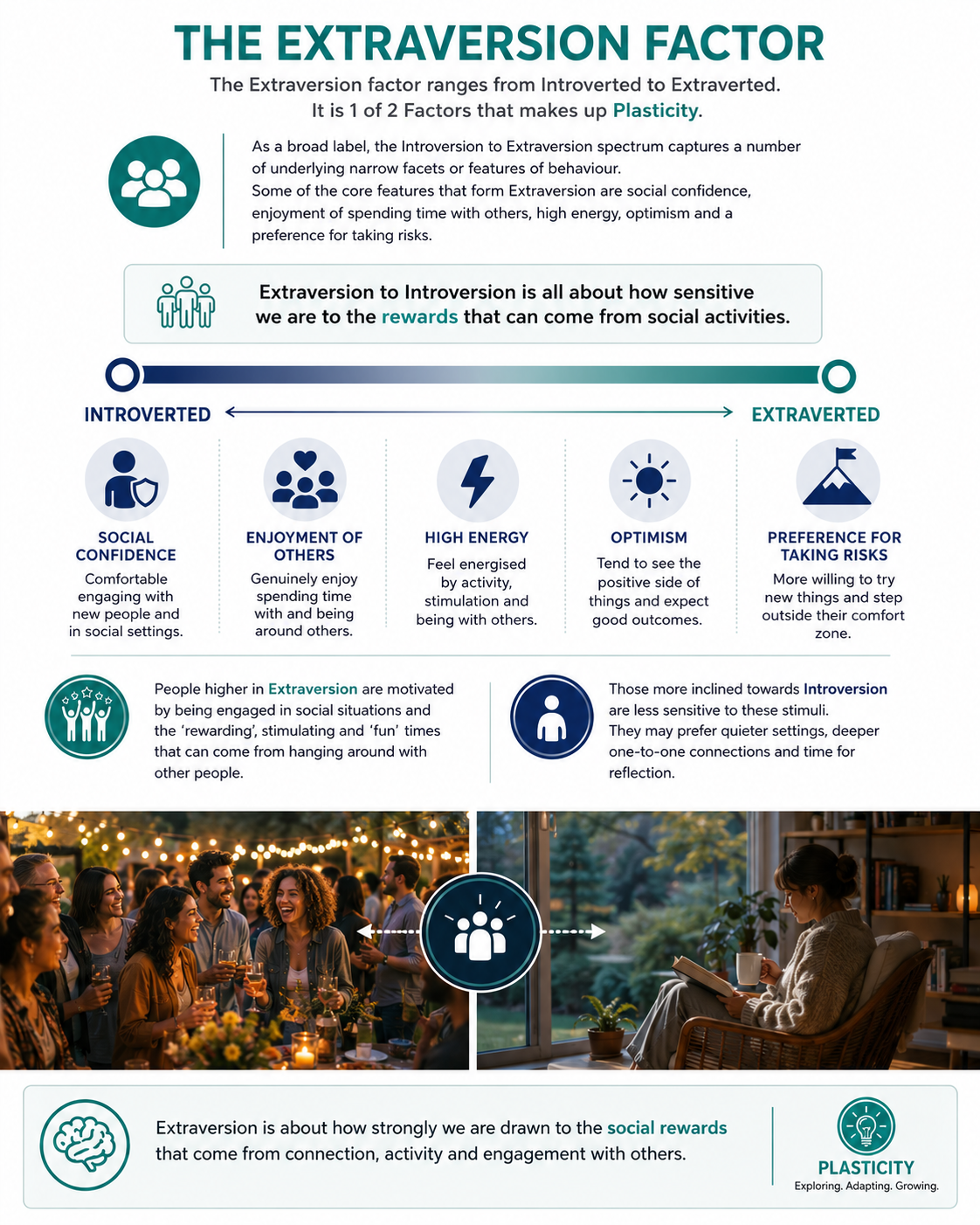
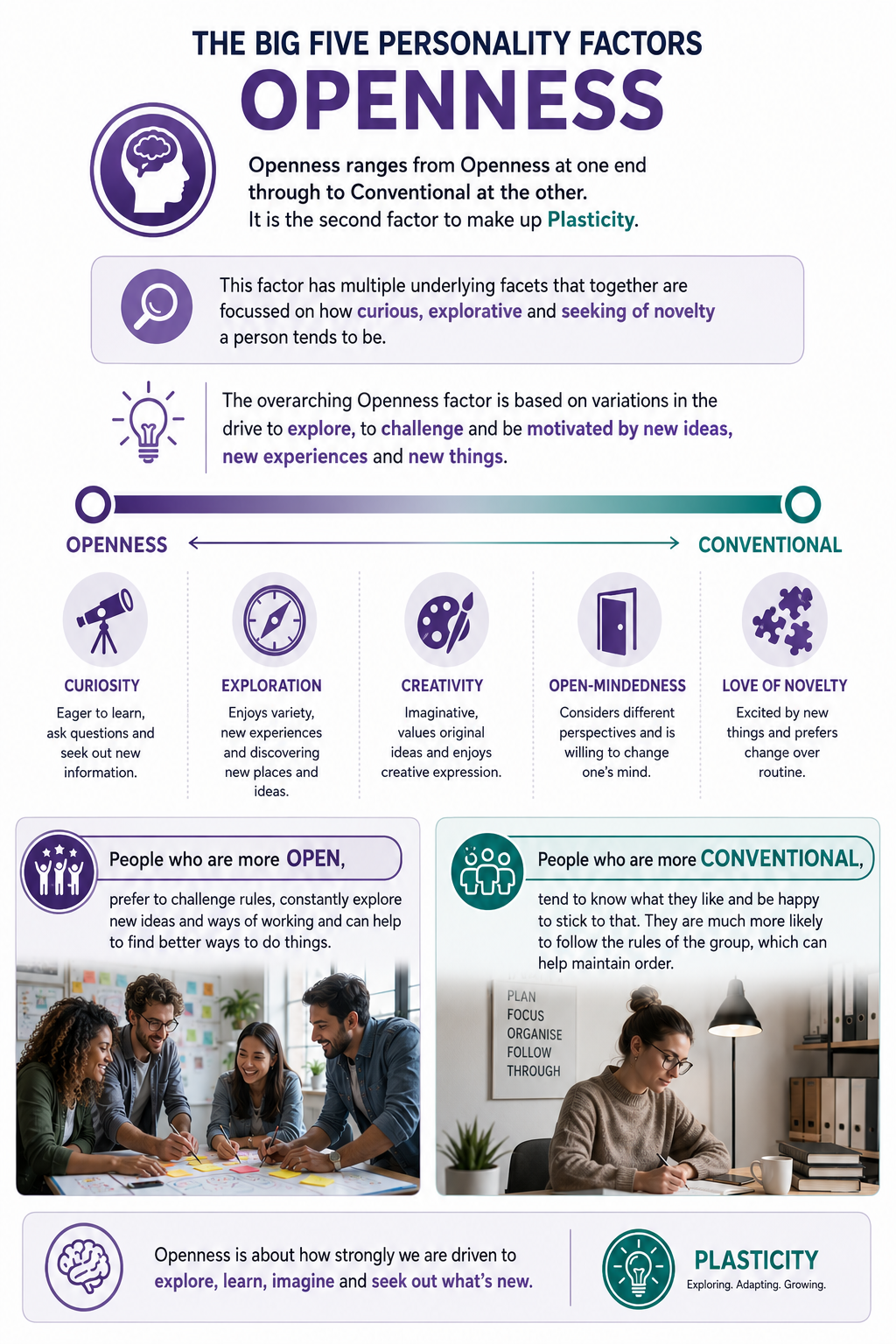
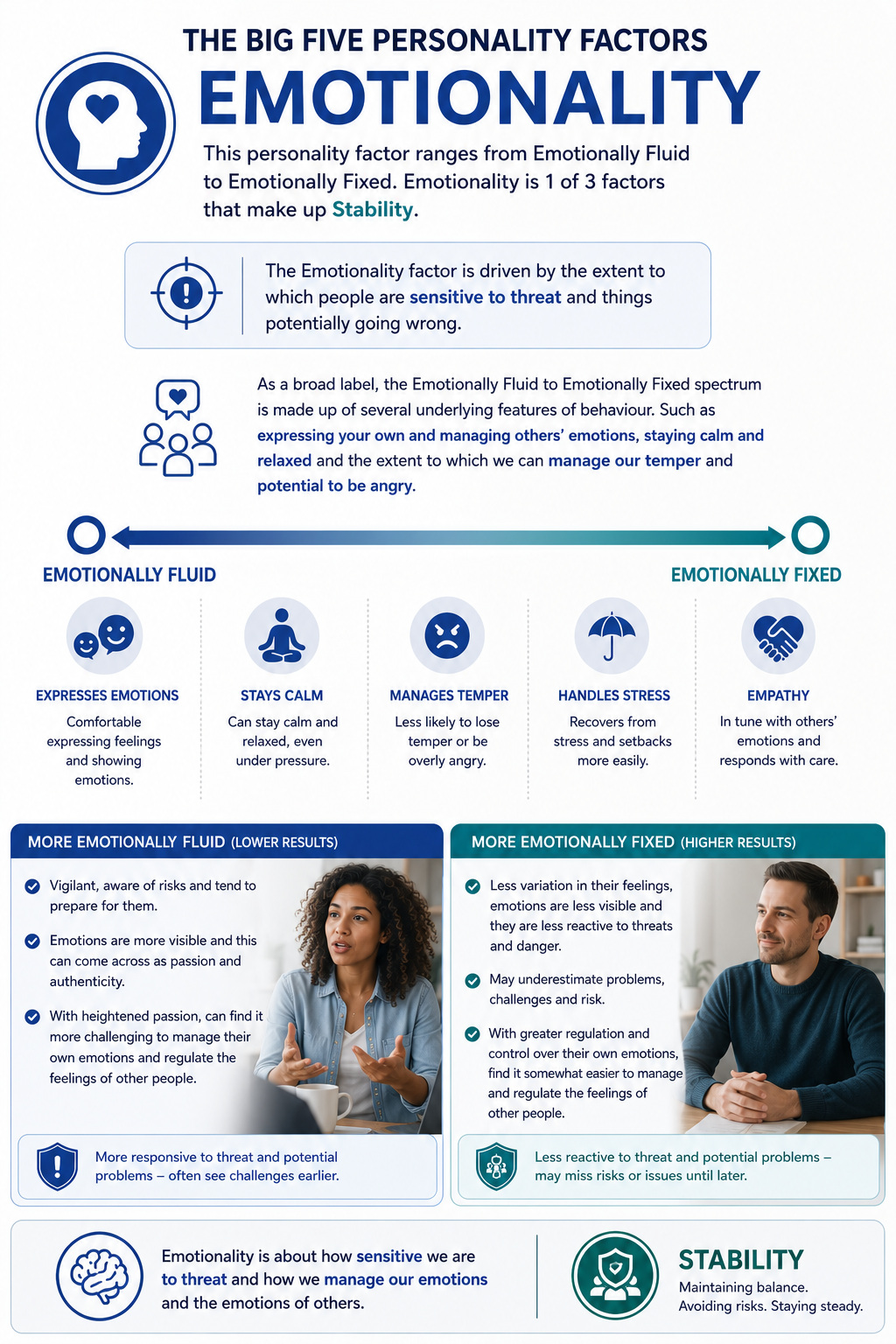
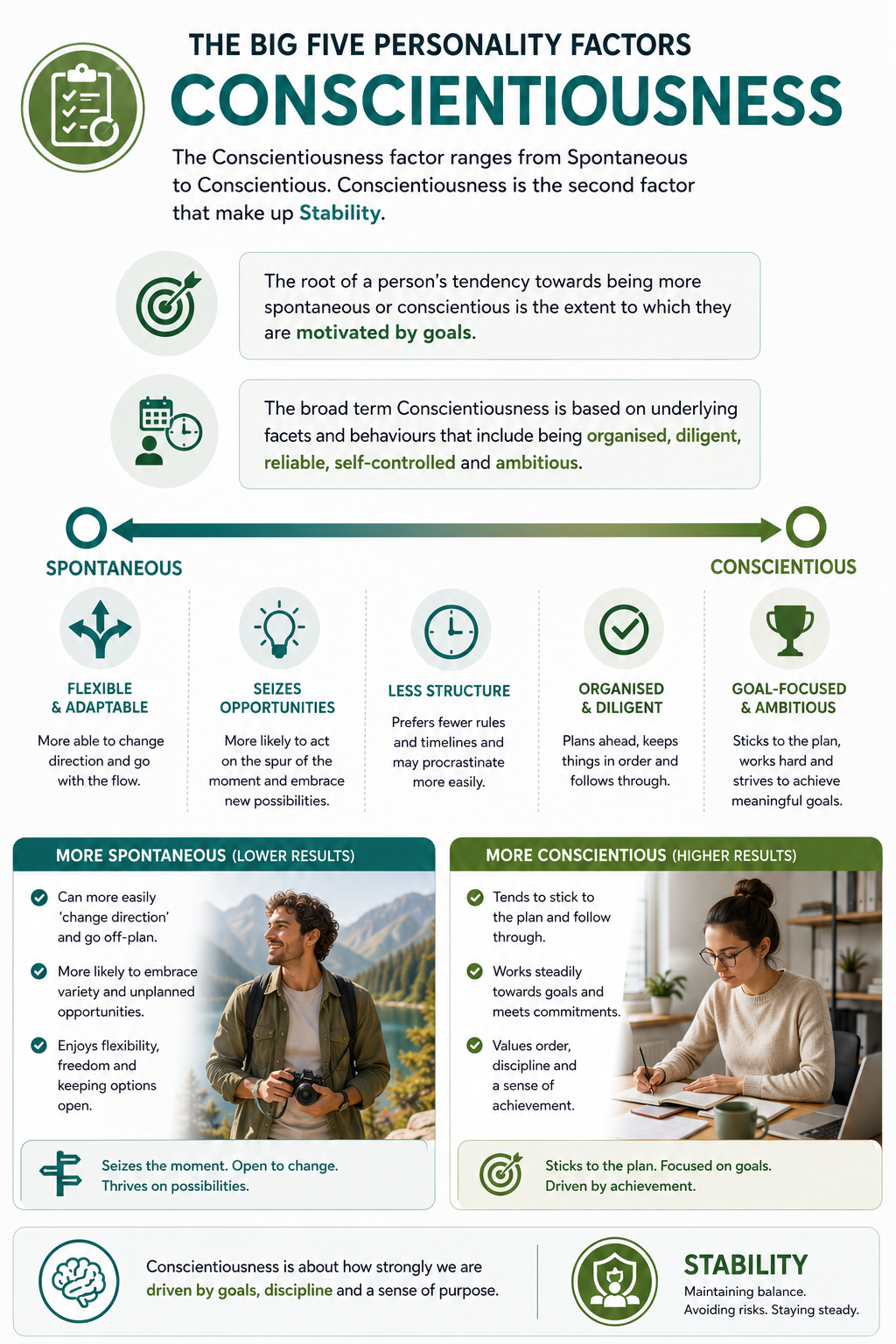

How does the Smartometric Assessment differ from other measures?
There are a number of ways that the assessment tool powering Smartometric Assessment has built on the foundations of the older psychometric assessments of the Big Five to reflect the latest science of personality and mindset.
First, to determine the exact nature of and placement of the 33 facets onto the five factors, an extensive content analysis was performed on different studies that have carefully examined the psychometric structure of each of the five factors independently. Each of these studies comprehensively examined exactly which facets could be accurately mapped onto a specific factor. This has allowed the Smartometric to be the most accurate representation of the structure of the Big Five as well as the Gigantic Two.
Facet to Factor Mapping Studies:
Openness
-
Christensen, A. P., Cotter, K. N., & Silvia, P. J. (2019). Reopening openness to experience: A network analysis of four openness to experience inventories. Journal of personality assessment, 101(6), 574-588.
Conscientiousness
-
Roberts, B. W., Lejuez, C., Krueger, R. F., Richards, J. M., & Hill, P. L. (2014). What is conscientiousness and how can it be assessed?. Developmental Psychology, 50(5), 1315.
Extraversion
-
Lucas, R. E., Diener, E., Grob, A., Suh, E. M., & Shao, L. (2000). Cross-cultural evidence for the fundamental features of extraversion. Journal of personality and social psychology, 79(3), 452.
-
Watson, D., & Clark, L. A. (1997). Extraversion and its positive emotional core. In Handbook of Personality Psychology (pp. 767-793). Academic Press.
Agreeableness
-
Crowe, M. L., Lynam, D. R., & Miller, J. D. (2018). Uncovering the structure of agreeableness from self‐report measures. Journal of Personality, 86(5), 771-787.
-
Lynam, D. R., Crowe, M. L., Vize, C., & Miller, J. D. (2020). Little evidence that honesty-humility lives outside of FFM agreeableness. European Journal of Personality, 34(4), 530-531.
-
Ashton, M. C., & Lee, K. (2007). Empirical, theoretical, and practical advantages of the HEXACO model of personality structure. Personality and Social Psychology Review, 11(2), 150-166.
Emotionality
-
Gross, J. J. (1998). The emerging field of emotion regulation: An integrative review. Review of General Psychology, 2(3), 271-299.
-
Gross, J. J. (2015). Emotion regulation: Current status and future prospects. Psychological Inquiry, 26(1), 1-26.
-
Niven, K. (2017). The four key characteristics of interpersonal emotion regulation. Current Opinion in Psychology, 17, 89-93.
-
Petrides, K. V., Furnham, A., & Mavroveli, S. (2007). Trait emotional intelligence: Moving forward in the field of EI. Emotional Intelligence: Knowns and Unknowns, 4, 151-166.
-
Petrides, K. V., & Furnham, A. (2000). On the dimensional structure of emotional intelligence. Personality and Individual Differences, 29(2), 313-320.
Secondly, the placement of the 33 facets of the assessment tool has been allowed to flow from the dominant science and confirmed using advanced statistical modelling of a large sample of people who completed the assessment using a technique called Confirmatory Factor Analysis. This has enabled the model to accurately reflect the likely reality of the facet structure of the Big Five. In contrast other models that measure the Big Five have a ‘forced model symmetry’ whereby each factor has the same number of facets. This is not because it mirrors the research but because it appears neat and tidy. The human mindset has not evolved in a neat and tidy manner to appear aesthetically pleasing. The greatest number of facets is found in the Extraversion factor which deals with people, arguably our most fundamental feature and therefore evolved to be more nuanced. Finally, by incorporating the latest science of the Gigantic Two, the assessment tool is the only measure to allow an exploration of all the layers of personality (Gigantic Two, Big Five and Facets).
Third, to ensure that the assessment tool is as comprehensive as possible, analyses were conducted to examine any potential ‘missing’ facets that are not covered by other models. This included Paunonen’s (2002) work on ‘Supernumerary traits’ and the vast study by Irwing, Hughes, Tokarev and Booth (2023) that examined 1772 items, across 61 potential base facets from 7 different personality measures. Further, potential overlap between facets was taken account of. This ensures the assessment tool does not accidentally measure the same aspects of mindset twice.
Fourth, the language and tone for each facet name, has been carefully selected to reduce the potential for bias, sounding judgemental and the initiation of ‘impression management’ and ‘socially desirable’ responses on the part of people who take the assessment. For example many of the earlier measures in this area had very clinical sounding facet labels like ‘Depression’ or ‘Dominance’ which tend to make participants shut down and activate their psychological immune system.
Fifth, we applied coaching psychology principles to create the feedback. This is rare for scientifically derived psychometrics, because most psychometricians (the people who do super-sophisticated maths and statistical modelling) have very rarely used a personality measure in real life.
Sixth, perhaps the most vital contribution to the science of human personality is our complete reworking and remodelling of what everyone else calls the Neuroticism factor we have create a totally new approach. Which is explained in some detail below.
Revealing Emotionality
A fundamental theory for personality is the Cybernetic Personality Systems Theory. This suggests that personality traits are the outward manifestation of internal psychological processes such as goals, mental models and the strategies we deploy in response to stimuli.
In a different area of psychology, emotion researchers have independently developed the concept that how we manage our emotions is also a cybernetic system.
Emotion regulation refers to the goal-directed processes through which individuals attempt to create, change or maintain emotional states.
Since both personality and emotional regulation are goal-directed psychological processes related to mental models and strategies, the two research areas must be integrated. This was achieved by surveying the work on emotion regulation and the growing literature on emotional intelligence to create five facets for the Emotionality factor.
The Emotionality factor combines the core elements of the old Neuroticism concept with the latest research on intelligent emotion management.
By incorporating emotional regulation research, we have shifted the Neuroticism factor from passive to active. The traditional Neuroticism factor describes how emotions are overwhelming without the capacity to influence them. The new Emotionality factor recognises the powerful emotions that can dominate thought but also identifies specific facets that enable the exploration of active strategies for monitoring and modifying emotional responses. This advancement should significantly enhance our capacity for personal development.
Furthermore, the integration of the two factors may have compromised the statistical and psychometric properties of Neuroticism. Fusing the two strands could have resulted in an unmanageable construct. Fortunately, the new Emotionality factor has excellent psychometric properties.
©2025-2026 Smartometric® from Smartability®. All rights reserved .