Know yourself. Grow yourself.
Unlock the power of your personality
Discover the 33 facets of your mindset and how your strengths drive your success
Get your personalised coaching report today
Smartometric Assessment
Assess the characteristic ways of your thinking, feeling and behaving.
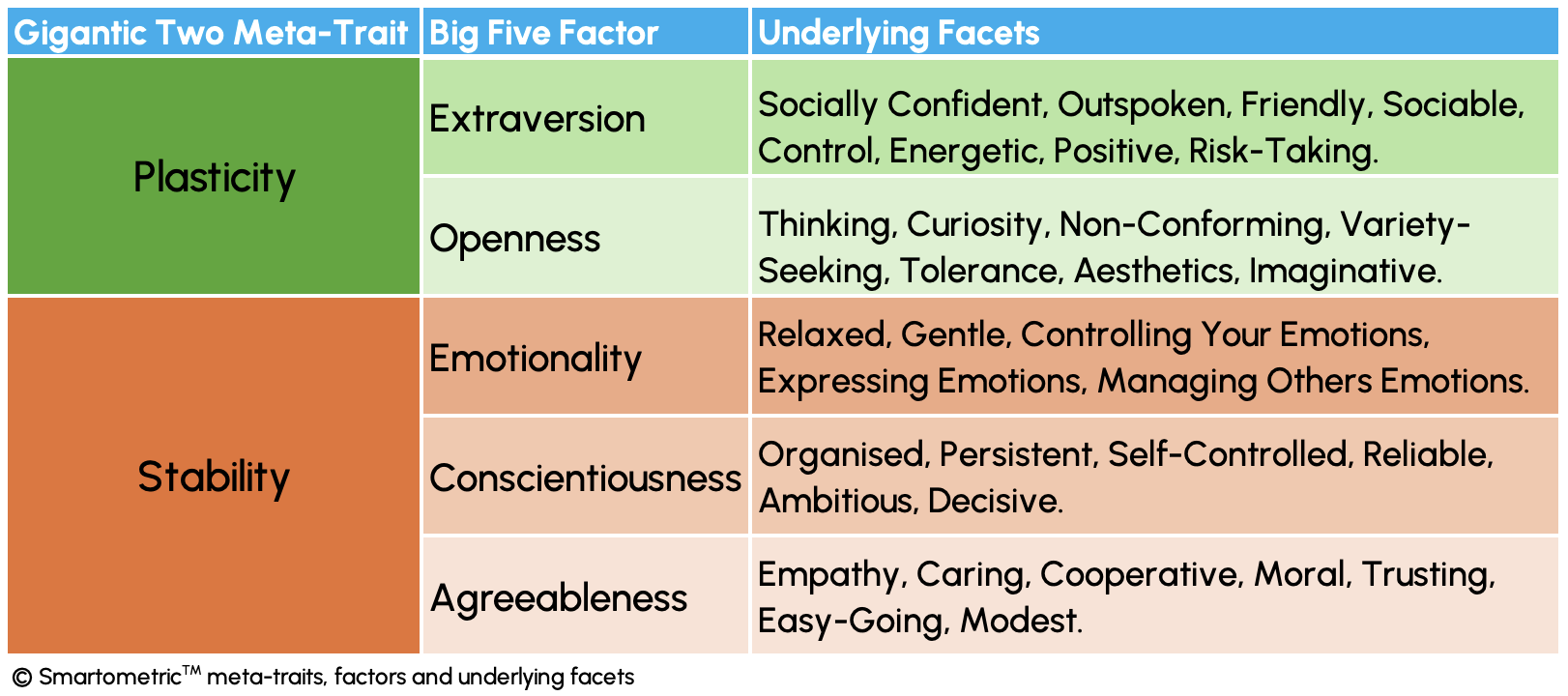
The Smartometric Assessment is an evolution of the most scientifically-grounded and validated measurement model of the hierarchical model of personality. It is the only measure that assesses the broad Gigantic Two ‘meta-traits’, the Big Five personality traits which places individuals on a spectrum based on the five major factors, and 33 facets that lie beneath them to deliver precise and targeted coaching advice.
In the Smartometric Assessment, you will complete a number of psychometric questions/statements (taking 25-30 minutes) and provide your rating for how you see yourself in relation to each question.
Your responses are compared to thousands of other people who have completed the same questions.
The Smartometric hierarchical model of personality
The Gigantic Two are the biggest, widest and most fundamental way of looking at personality. They are based on the biological, basic building block tradition of personality. One of these ‘mega-traits’ is called Plasticity and the other is called Stability.
-
Plasticity is the extent to which someone tends to prefer exploration, novelty and flexibility in their thinking and behaviour
-
Stability is the extent to which someone tends to control their emotions and prefer order and social harmony
Each person has natural variation across these two Gigantic Factors/Mega-traits. They have their own preference for novelty and flexibility (Plasticity) AND their own preference for regulating their emotions, behaviour and environment (Stability).
Extraversion: The extent to which someone tends to be outgoing, energetic and enjoy social interaction.
-
Socially Confident: The extent to which someone tends to “be confident in social situations”.
-
Outspoken: The extent to which someone tends to “express their opinions clearly”.
-
Friendly: The extent to which someone tends to “be warm and welcoming”.
-
Sociable: The extent to which someone tends to “enjoy being in the company of other people”.
-
Control: The extent to which someone tends “to take control of situations”.
-
Energetic: The extent to which someone tends “to be busy and active”.
-
Positive: The extent to which someone tends to be “hopeful and optimistic”.
-
Risk-Taking: The extent to which someone tends to “engage in stimulating and exciting activities”.
Openness: The extent to which someone tends to be curious and open to new ideas and people.
-
Thinking: The extent to which someone tends to “enjoy thinking and reasoning”.
-
Curiosity: The extent to which someone tends “to desire to know and learn”.
-
Non-Conforming: The extent to which someone tends to “be different from the norm”.
-
Variety-seeking: The extent to which someone tends to “to choose to do things differently”.
-
Tolerance: The extent to which someone tends “to be open-minded and tolerant of difference”.
-
Aesthetics: The extent to which someone tends to be devoted to beauty and the seeking of experiences that are attractive to the senses.
-
Imaginative: The extent to which someone tends to “have creative and original ideas”.
Emotionality: The extent to which someone tends to be outgoing, energetic and enjoy social interaction.
-
Relaxed: The extent to which someone tends to “be calm and manage anxiety”.
-
Gentle: The extent to which someone tends to “be patient and manage anger”.
-
Controlling Your Emotions: The extent to which someone tends “to understand and manage their own emotions and feelings”.
-
Expressing Emotions: The extent to which someone tends to “express their emotions and feelings”.
-
Managing Others Emotions: The extent to which someone tends to “deliberately influence other people’s emotions and feelings”.
Conscientiousness: The extent to which someone tends to be disciplined, dependable and focused on goals.
-
Organised: The extent to which someone tends “to be ordered and focussed on details”.
-
Persistent: The extent to which someone tends to “be hard working”.
-
Self-controlled: The extent to which someone tends to “control their impulses”.
-
Reliable: The extent to which someone tends to “be trustworthy and reliable”.
-
Ambitious: The extent to which someone tends to be competitive and desire success.
-
Decisive: The extent to which someone tends to “to make quick decisions”.
Agreeableness: The extent to which someone tends to be cooperative, caring and concerned with social harmony.
-
Empathy: The extent to which someone tends to “understanding of other people”.
-
Caring: The extent to which someone tends to “to actively help others”.
-
Cooperative: The extent to which someone tends “to work with others to achieve shared goals”.
-
Moral: The extent to which someone tends to “follow rules and conventions”.
-
Trust: The extent to which someone tends to “believe others”.
-
Easy going: The extent to which someone tends “to be gentle and easy to live with”.
-
Modest: The extent to which someone tends to “be humble about their abilities and achievements”.
Reporting and feedback
How you see yourself and how your personality is revealed
The Smartometric Assessment provides you with feedback on your Gigantic Two ‘meta-traits’, five personality factors plus giving you detailed feedback on every one of the 33 underlying facets that make up these factors.
The reporting includes three parts, giving you an overall reflective feedback on each facet, a detailed outlined of your key strength for that facet, plus a corresponding outline of suggestions for your development.
In addition, the reporting provides feedback on the difference (if any) between your self-perception (how you view and interpret your own personality, abilities, and behaviour) and that which is measured through the Smartability Assessment. This additional feedback is very useful in reflecting how and why you may have a different perception of yourself than what your assessment reveals about you.
©2025-2026 Smartometric® from Smartability®. All rights reserved .